- Voicing
- Tongue placement
- Diphthongs and tripthongs
- Rhotic vowels
- Lip rounding
- Tense v. lax
Basic Vocabulary
- /i/ as in beat
- /I/ as in bit
- /eI/ as in bait
- /ɛ/ as in bet
- /æ/ as in bat
- /u/ as in boot
- /Ʊ/ as in book
- /oƱ/ as in boat
- /ɔ/ as in caught
- /ə/ as in about
- /ʌ/ as in but
- /ɚ/ as in butter
- /ɝ/ as in Bert
- /a/ as in plot
- /aI/ as in bite
- /aƱ/ as in bout
- /ɔI/ as in boil
- /Iɚ/ as in peer
- /ɛɚ/ as in fair
- /aɚ/ as in Bart
- /Ʊɚ/ as in pure
- /ɔɚ/ as in court
- /aIɚ/ as in fire
- /aƱɚ/ as in tower
The Vowel Sounds
-
Voicing
As we’ve already seen, voicing is the vibration of the vocal chords and an important part of how consonants are described. This doesn’t work with the vowel sounds.
Make the /i/ sound. It’s voiced, right? Now, do the same with /u/. It’s voiced, too. In English, all vowels are voiced. In fact, most vowels are voiced in all languages. Voiceless vowels are extremely uncommon.
-
Tongue placement
We can’t use manner and place of arituclation for vowels. Make an /f/. You feel how you lower lip curls back to your teeth, right? Now make a /u/ sound. Your tongue is pulled back in your mouth, but it’s not touching anything. So place of articulation is out the window. Manner of articulation is, too, because it describes how we restrict the airflow to make sounds. Vowels don’t restrict airflow, either. So, we use tongue placement.
We divide the mouth in quadrants: front, mid, and back and high, mid and low. Look at this chart:
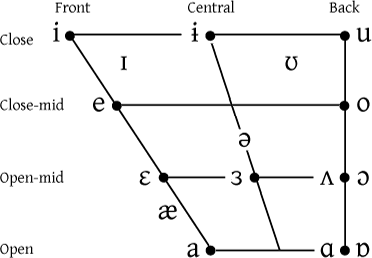
So, when we describe a vowel, we use tongue placement and the tense v. lax distinction. (see below), so the /i/ sound is a high, front vowel.
A few notes here:
1. There are a few sounds on this chart that aren’t found in general American English, so they aren’t discussed here.2. This chart had the close-mid and open-mid distinctions. We’re just going to call them all mid vowels.
3. This chart says “close” and “open”, we’ll use “high” and “low”, respecitvely.
3. You’ll notice that some symbols are missing. See the discussion of Diphthongs below for more information. -
Diphthongs and Triphthongs
Diphthongs are essentailly two vowel sounds shoved together. English has several, /eI/, /oƱ/, /aI/, /aƱ/, /ɔI/ and many of the rhotic vowels. When discussing tongue placement, The diphthongs /aI, aƱ, ɔI/ are pulled out because the tongue moves when you make those sounds.
Make the /eI/ sound. Feel how your tongue doesn’t really move? Now make the /aƱ/ sound. Feel how your mouth moves? That makes describing them much more complicated. So, for the purposes of our classes, we’ll just call /aI, aƱ, ɔI/ “Diphthongs”. Just remember that they aren’t the only diphthongs we have.
Tripthongs are three vowel sounds smashed together. Most dialects of English don’t have them. However, the English spoken in Australia and New Zealand does.
-
Rhotic Vowels
The r sound does some interesting things. When it starts a word or syllable, like in “run”, or part of a consonant cluster, like “brush”, it’s a consonant. When it ends a syllable or a word, like “fur”, or just follows a vowel, like “start”, it is a vowel sound. Sometimes, it stands on its own, like in “heard”, sometimes it combines with another vowel sound to make a rhotic diphthong, like in “tear”.
-
Lip rounding
Some vowels require lip rounding. Make the /u/ sound. Feel how your lips round? That’s how it works. In English, lip-rounding only occurs with back vowels.
Many languages, like French and German, have front, rounded vowels.
-
Tense v. lax
Along with tongue placement, this is one of the contrasts used to describe vowels in English. Tense vowels usually involve effort to pronounce than lax vowels. Make an /i/ sound. Do you feel how your jaw is moving forward and your mouth is opening up like your smiling? Now make an /I/ sound. Your tongue is in the same area as when you make an /i/ but your jaw is moving really, and your mouth isn’t opening as much. That makes it lax.
So, these vowels are described this way: /i/: high, front, tense vowel, while /I/ is a high, front, lax vowel.
Vocabulary defined

-
/i/
Sample words: meet, eternal, fee
Description: High, front, tense
-
/I/
Sample words: ill, tip, rhythm
Description: High, front, lax
-
/eI/
Sample words: Ale, plate, grey
Description: Mid, front, tense
-
/ɛ/
Sample words: Fred, net, speck
Description: Mid, front, lax
-
/æ/
Sample words: Canada, banana, plant
Description: Low, front, lax
-
/u/
Sample words: usual, Hugh, blue
Description: High, back, tense
-
/Ʊ/
Sample words: wood, should, cook
Description: High, back, lax
-
/oƱ/
Sample words: oath, poke, flow
Description: Mid, back, tense
-
/ɔ/
Sample words: coffee, fraught, bought
Description: Mid, back, lax
In many North American English dialects, this sound has merged with /a/ (see below).
-
/ə/
Sample words: before, nation, alone
Description: Mid, mid, lax
This is the schwa, an unstressed vowel. It is very short, and it said very quickly.
-
/ʌ/
Sample words: mug, pluck, love
Description: Mid, mid, lax
This vowel, the carat, is closely related to the schwa. It’s basically the schwa but longer. It’s actually more complicated than that. but this explanation will work for now.
-
/ɚ/
Sample words: perfection, actor, separate (when it’s a verb)
Description: Mid, mid, lax
This is the rhotic version of the schwa.
-
/ɝ/
Sample words: colonel, person, unfurl
Description: Mid, mid, lax
This is the rhotic version of the carat.
-
/a/
Sample words: plot, dot, lot
Description: Low, back, tense
In many North American dialects, /ɔ/ is merging with this sound. Also, sometimes, this is called a low, mid vowel.
-
/aI/
Sample words: island, kite, fly
Description: Diphthong
-
/aƱ/
Sample words: owl, house, plow
Description: Diphthong
-
/ɔI/
Sample words: oil, avoid, toy
Description: Diphthong
-
/Iɚ/
Sample words: near, jeer, cheer
Description: High, front, rhotic
-
/ɛɚ/
Sample words: care, share, flair
Description: Mid, front, rhotic
-
/aɚ/
Sample words: arch, tar, alarm
Description: Low, back, rhotic
-
/Ʊɚ/
Sample words: cure, sure, lure
Description: High, back, rhotic
-
/ɔɚ/
Sample words: order, fore, pour
Description: Mid, back, rhotic
-
/aIɚ/
Sample words: hire, admire, liar
Description: Rhotic diphthong
-
/aƱɚ/
Sample words: flour, shower, cower
Description: Rhotic diphthong
The Vowels in Detail

This entry is licensed under a Creative Commons Attribution-NonCommercial-ShareAlike 4.0 International license.


Recent Comments